
Phishing has always been about deception, but today, it’s not just about a fake email. It’s about obfuscation and infrastructure.
Attackers now build entire ecosystems of redirectors, cloud storage, and short-lived domains to host credential-stealing pages. The result is faster-moving, harder-to-detect phishing activity that often outpaces traditional blocklists or static indicators.
That’s where phishing threat intelligence comes in.
Rather than focusing on individual emails or attachments, phishing threat intelligence maps the web infrastructure behind these campaigns — domains, URLs, IPs, and the contextual data that connects them.
A Real Example: The Voicemail Phish
In a recent phishing campaign targeted at us and analyzed by the alphaMountain threat intelligence team, the lure was simple:
Subject: “Message from Alphamountain”
Body Title: “You’ve Got Voicemail”
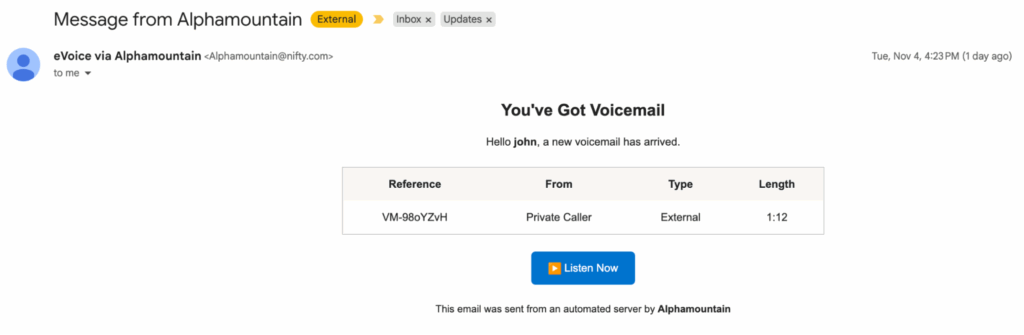
There are several noteworthy facets of this email that would ultimately enhance its effectiveness as a phishing attack:
- The subject and footer both contain our organization name. This effectively lowers trust barriers to opening the email (and potentially assists in evading spam or threat filters).
- The “from” email address features our company name in the prefix. At first glance, this could easily be from an account set up for our team.
- The inclusion of the addressee’s name in the subtitle of the message adds another trust signal that everyday users will key in on.
The user’s click launched a series of redirects:
- Initial click on the button goes to
secure-web.cisco.comwith subsequent redirects built into the URL:
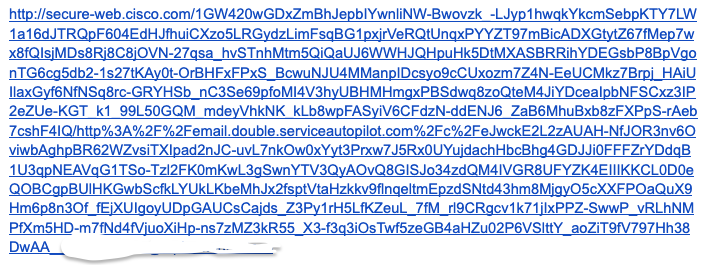
- Which leads to a legitimate marketing domain (
email.double.serviceautopilot.com) - Which leads to a temporary Amazon S3 bucket used as a redirector
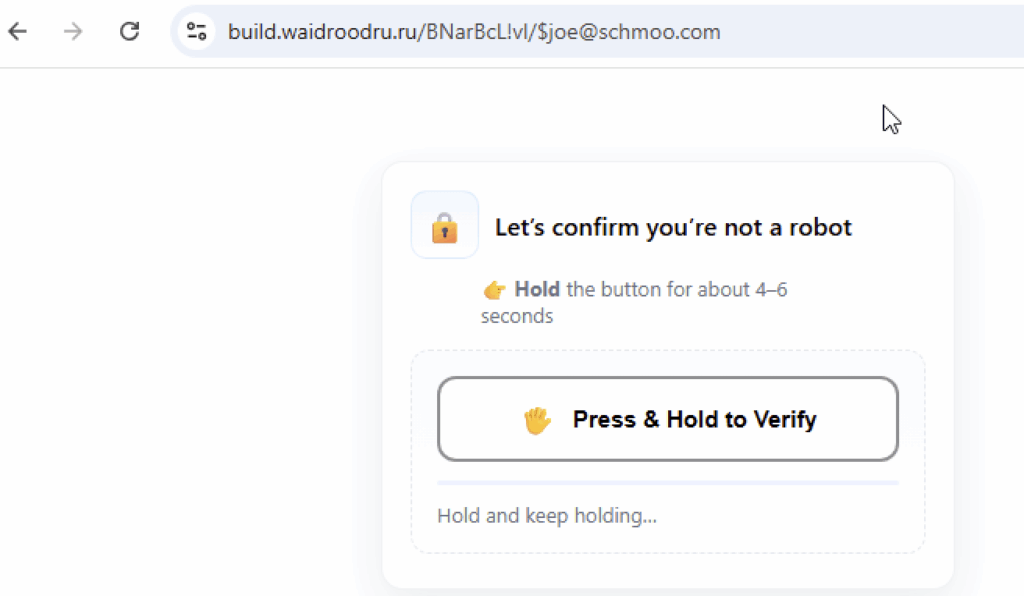
- And finally, a series of roundtrip redirects to a phishing destination harvesting Google Gmail account credentials on
build.waidroodru.ruviacraihouki.za.com.
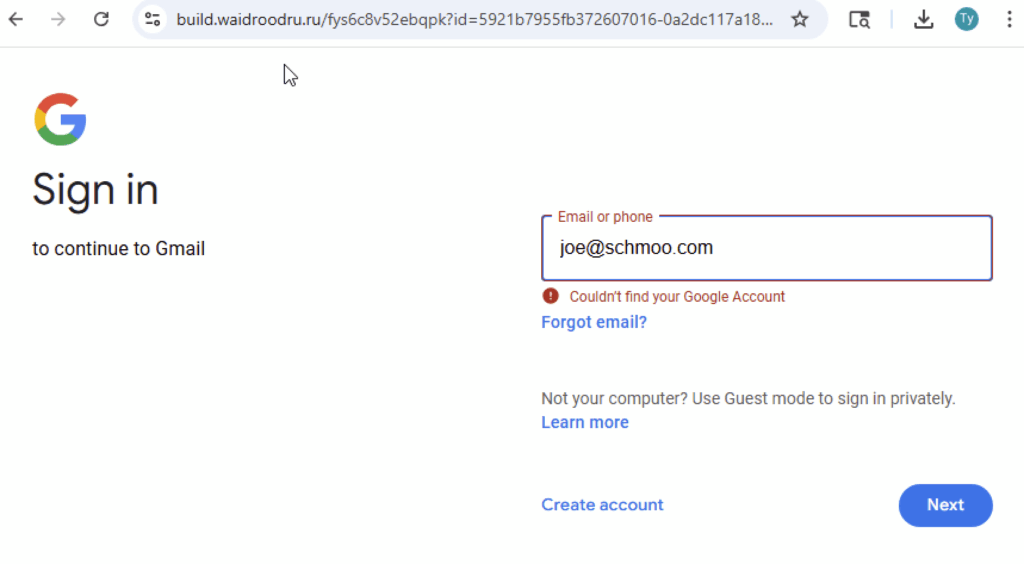
To a human, the first URL looked safe, and indeed it was.
To alphaMountain’s machine learning model, it was a high-risk redirect pattern — a textbook case of phishing infrastructure in motion.
What Phishing Threat Intelligence Really Provides
True phishing threat intelligence goes beyond just labeling a link “Phishing.” It provides context — insight into the behaviors, relationships, and infrastructure that make a URL risky.
alphaMountain’s URL Threat Intelligence Data delivers that context to cybersecurity vendors through:
- Real-Time URL and Domain Risk Ratings
Each domain or URL receives a single, AI-scored rating from 1.00–10.0, reflecting threat level. - 92 Content and Risk Categories
Beyond “malicious vs. safe,” alphaMountain classifies domains into 92 detailed categories (including Phishing, Suspicious Infrastructure, Cloud Storage Abuse, and Newly Registered Domains). - Contextual Indicators
Each record can include Passive DNS (pDNS), GeoIP, related hosts, and computed threat factors — helping technology partners understand why a domain is risky. - Hourly Data Refresh
Our datasets update every hour, ensuring our partners’ products always reflect the latest phishing and malware campaigns.
Why URL Threat Intelligence Is Key to Phishing Detection
Modern phishing detection isn’t just about scanning email content. Security technologies — from email gateways and XDRs to threat-intel platforms and SOAR tools — rely on accurate, timely phishing threat intelligence to make automated, real-time decisions.
Here’s how alphaMountain data helps them do it:
| Challenge | What alphaMountain Data Adds |
|---|---|
| Redirect chains through legitimate domains | Detects threats at every hop |
| Temporary cloud storage hosting phishing pages | Flags “Information Technology” category |
| Rapidly rotating domains and new TLDs | Real-time detection via hourly updates |
| Manual or conflicting verdicts from legacy feeds | Unified threat rating (1.00–10.0) for clear automation |
By enriching security controls with high-fidelity phishing threat intelligence, vendors can identify emerging phishing campaigns before traditional engines even register them.
How Cybersecurity Vendors Use Phishing Threat Intelligence
alphaMountain’s URL and domain intelligence feeds are used by:
- Email security providers to evaluate embedded links in real time.
- SOAR and SIEM platforms to enrich phishing alerts with contextual risk data.
- Threat intelligence platforms (TIPs) to correlate indicators across campaigns.
- XDR and MDR solutions to surface phishing-related infrastructure in investigations.
Our data empowers these systems to detect and respond to phishing infrastructure faster — without waiting for signature updates or human triage.
Smarter Data for Smarter Defenses
Phishing is constantly evolving, but its infrastructure always leaves a trace — domains, redirects, and patterns of behavior that can be detected with the right data.
That’s the role of phishing threat intelligence: giving cybersecurity technology vendors the high-fidelity, real-time insight they need to stay ahead of attackers.
alphaMountain’s URL Threat Intelligence Database provides that visibility — updating hourly, categorizing at scale, and delivering context your products can trust.