
Google Safe Browsing Alternative for Enterprise Security — alphaMountain vs. Google Web Risk
Security teams looking for a Google Safe Browsing alternative — or evaluating Google Web Risk as an enterprise URL classification feed — need to see the data before committing. We ran 10 live, high-risk domains through both alphaMountain’s aM Intelligence API (via threatYeti) and Google Safe Browsing, the publicly accessible equivalent of Google Web Risk sharing the same underlying classification technology. alphaMountain flagged all 10 domains with threat scores ranging from 7.56 to 9.18. Google Safe Browsing confirmed only 2 as unsafe, returned an active “no unsafe content found” verdict on 3 — including a confirmed phishing domain — and had no data at all on the remaining 5. The detection gap is significant, and the data below shows exactly where it breaks down.
A Note on Google Safe Browsing vs. Google Web Risk
Google Safe Browsing is the free, browser-integrated threat detection layer that powers Chrome's "Dangerous Site" warnings and is publicly queryable via the Google Transparency Report. Google Web Risk is the commercial API version — sold to enterprises and security vendors — that Google explicitly states is built on the same underlying analysis technology. For the purposes of this comparison, Safe Browsing results serve as a direct proxy for what Web Risk would return: they draw from the same classification engine, the same blocklist infrastructure, and the same update cadence. If Safe Browsing can't catch a threat, neither can the Web Risk API.
Comparison Methodology
We selected 10 domains independently identified as suspicious or malicious through threat hunting activity. Each domain was queried against alphaMountain's aM Intelligence engine via threatYeti (the free analyst interface to the same underlying API) and against Google's Transparency Report Safe Browsing checker at transparencyreport.google.com/safe-browsing/search — which reflects real-time Safe Browsing / Web Risk verdicts. Queries were run in May 2026. No domains were pre-screened for known Safe Browsing status; the sample reflects organic threat hunting output.
The Same Domain. Two Very Different Verdicts.
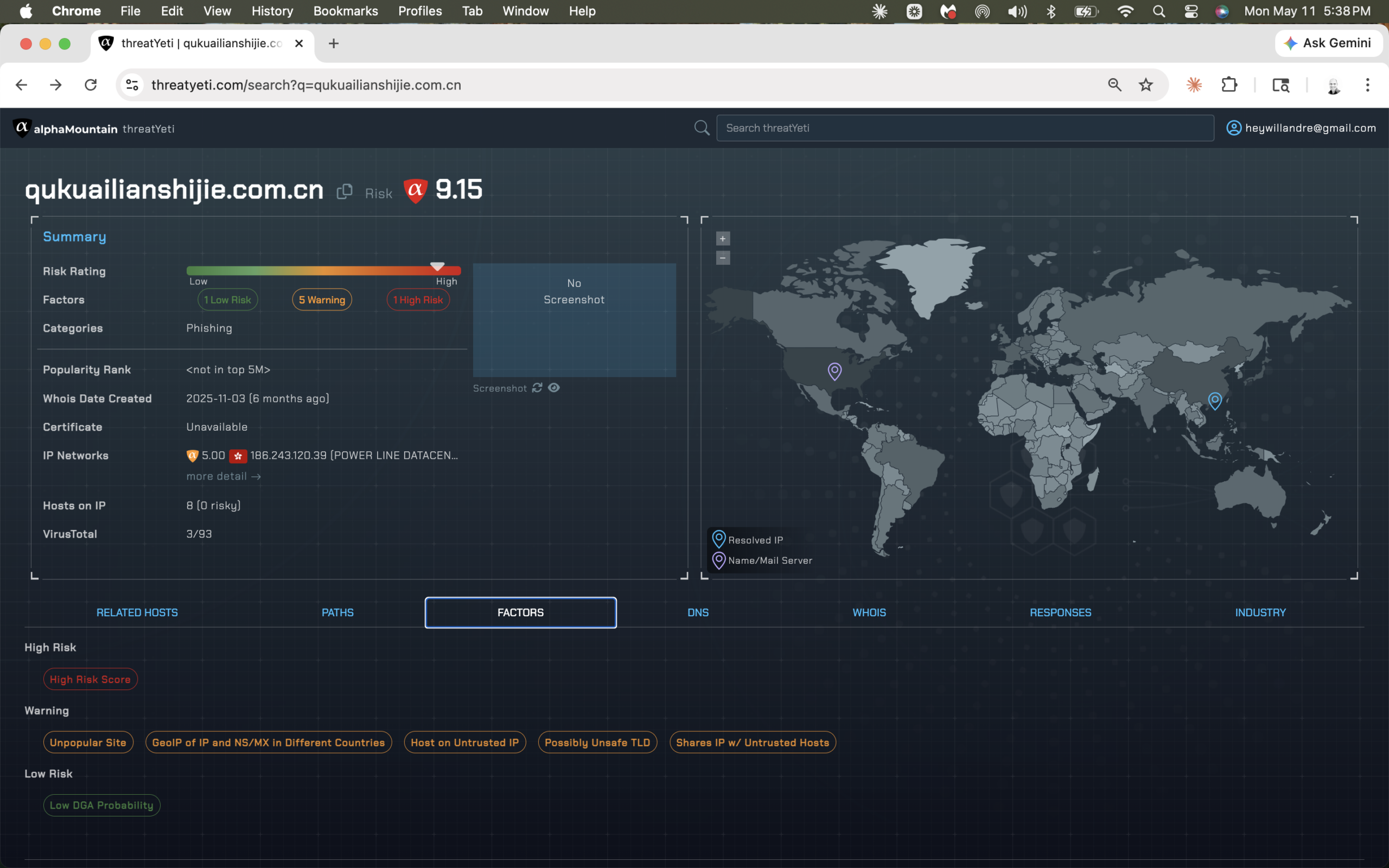
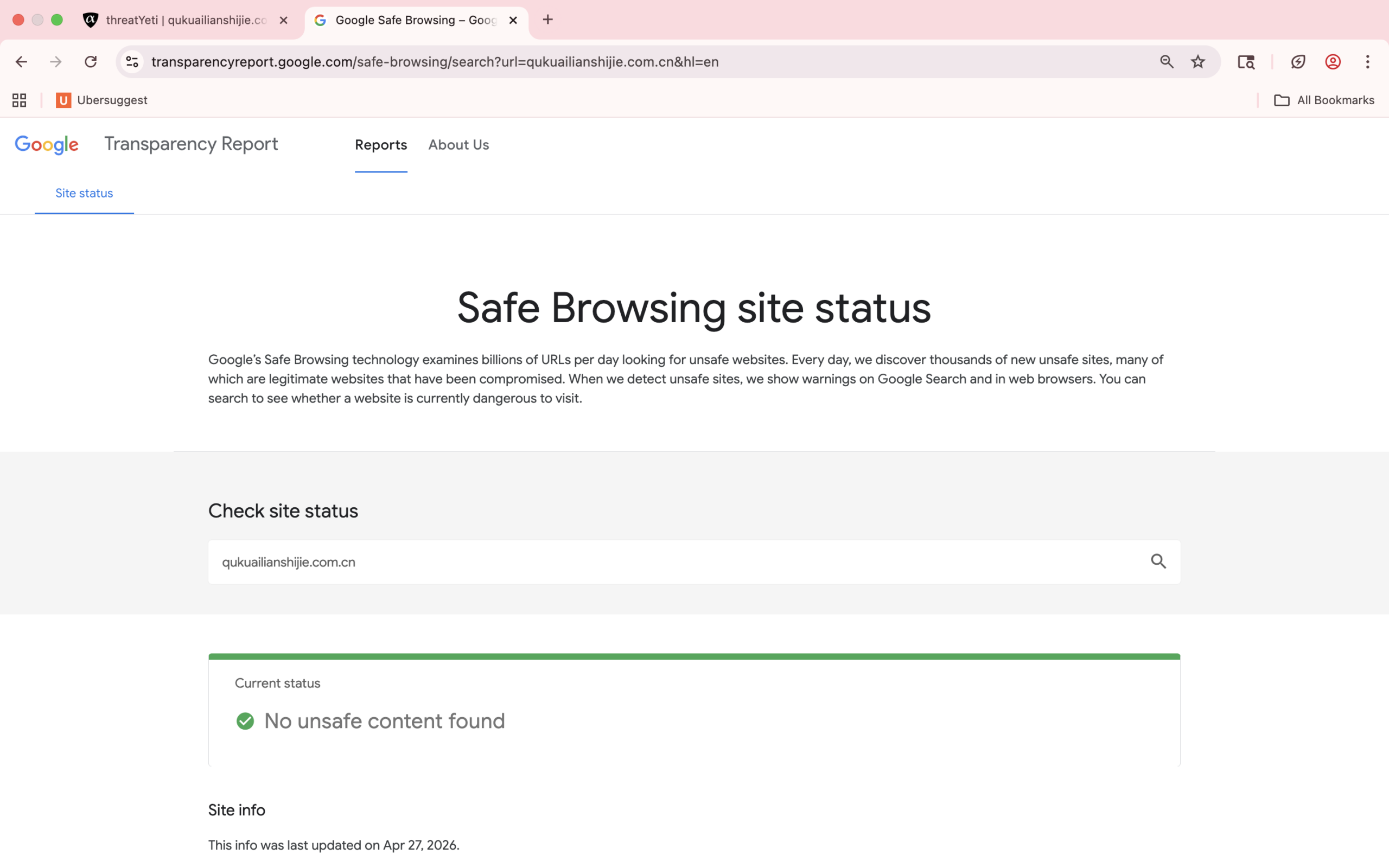
qukuailianshijie.com.cn — a confirmed phishing domain — rated 9.15 by alphaMountain and actively cleared as safe by Google Safe Browsing as of April 2026.
Domain-by-Domain Findings
| Domain | alphaMountain Score | aM Category | Google Safe Browsing / Web Risk | Outcome |
|---|---|---|---|---|
| hsbc-uat.heals.asia | 9.18 | Health, Phishing | ⚠ This site is unsafe | Both flagged |
| qukuailianshijie.com.cn | 9.15 | Phishing | ✓ No unsafe content found | Google missed — active false negative |
| tesco-offerredeem.bond | 8.50 | Malicious | ⚠ This site is unsafe | Both flagged |
| pvp8q7.sbs | 7.65 | Suspicious | — No available data | aM only — Google blind |
| precisionfitnesspathway.click | 7.63 | Suspicious | ✓ No unsafe content found | Google missed — active false negative |
| biz8eaa0lv.sbs | 7.63 | Suspicious | — No available data | aM only — Google blind |
| 50770.my | 7.61 | Suspicious | — No available data | aM only — Google blind |
| 025128.com | 7.60 | Suspicious | ✓ No unsafe content found (data from May 2020) | Google missed — stale by 6 years |
| bet959.top | 7.59 | Suspicious | — No available data | aM only — Google blind |
| 803ohm.top | 7.56 | Spam | — No available data | aM only — Google blind |
Key Takeaways
- Google Web Risk operates on a reactive blocklist model. It's effective at confirming threats that have already been widely reported and processed — but in this sample, only 2 of 10 risky domains triggered a confirmed "unsafe" verdict. The other 8 were either unknown to the system or actively cleared as safe.
- Newly registered domains are a systematic blind spot. Five of the ten domains had no Safe Browsing data at all. Of those, several were registered within the past 30 days — including pvp8q7.sbs (23 days old), 803ohm.top (29 days old), and tesco-offerredeem.bond (3 days old). alphaMountain's behavioral and contextual scoring flagged all five with risk scores above 7.5.
- A confirmed phishing domain (9.15 risk score) was rated clean by Google. qukuailianshijie.com.cn was classified as Phishing by alphaMountain with a risk score of 9.15. Google Safe Browsing's verdict as of April 27, 2026: "No unsafe content found." This isn't a stale record — Google had evaluated the domain and cleared it.
- Google's data can be years out of date. 025128.com was last assessed by Safe Browsing on May 28, 2020 — over six years before this comparison. The domain is currently registered, actively resolving, and scored 7.60 by alphaMountain. The domain changed ownership within the last 12 months.
- alphaMountain provides category specificity that binary verdicts can't. Google's output is a binary: safe or unsafe. alphaMountain returns threat scores, specific risk factors (e.g., "Newly Registered," "Shares IP w/ Risky Hosts," "High DGA Probability"), and actionable categories — enabling security teams to tune detection thresholds rather than rely on a single pass/fail verdict.
About alphaMountain
alphaMountain is a domain and URL threat intelligence company. Its aM Intelligence API classifies URLs and domains across 70+ categories with probabilistic threat scores — built for embedding into DNS security products, secure web gateways, SWG platforms, MSSPs, and enterprise threat intel pipelines. threatYeti is alphaMountain's free analyst interface for threat hunters and security researchers.
Frequently Asked Questions
Is Google Web Risk accurate enough for enterprise threat detection?
Google Web Risk is well-suited for blocking confirmed, high-volume threats — phishing pages and malware distribution sites that have already accumulated enough reports to appear in Google's blocklist. Where it underperforms is in the detection of newly registered domains, low-prevalence threats, and domains that haven't yet been broadly reported. In our test of 10 suspicious and malicious domains, Google Safe Browsing (which uses the same underlying technology as Web Risk) confirmed only 2 as unsafe and returned a clean verdict on 3 actively risky domains — including a confirmed phishing site with a 9.15 risk score.
How does alphaMountain compare to Google Web Risk for URL classification?
alphaMountain's aM Intelligence API is a purpose-built URL and domain classification engine, not a consumer safety product with an API layer added on. Where Google Web Risk provides binary safe/unsafe verdicts based on known-bad blocklists, alphaMountain returns probabilistic threat scores (0–10) and classification across 70+ categories — including specifics like Phishing, Spam, High DGA Probability, Newly Registered, and dozens more. This gives security teams the signal granularity needed to tune detection thresholds and make contextual decisions, rather than depending on a single blocklist verdict.
What is the difference between Google Safe Browsing and Google Web Risk?
Google Safe Browsing is the free, browser-integrated version — it powers Chrome's "This site may be dangerous" warnings and is publicly queryable via the Google Transparency Report. Google Web Risk is the commercial API version, designed for enterprises and security vendors, and priced accordingly. Both draw from the same underlying threat database and classification engine. For practical evaluation purposes, Safe Browsing results are a reliable proxy for what Web Risk would return on a given domain.
Does alphaMountain detect newly registered domains that Google Web Risk misses?
Yes — and this comparison illustrates why. Five of the ten domains in our sample had "No available data" in Google Safe Browsing, meaning Google's systems had no verdict at all. Several of those domains were registered within the past 30 days. alphaMountain's scoring model incorporates registration age, IP neighborhood risk, TLD risk profiles, DGA probability, and dozens of additional behavioral signals — enabling it to assign meaningful risk scores to newly registered domains before they appear on any blocklist.
What's the best Google Web Risk alternative for security product vendors?
For security vendors, MSSPs, and enterprise security teams that need to embed URL and domain classification directly into products or pipelines, alphaMountain's aM Intelligence API is built specifically for that use case. It's vendor-neutral, SLA-backed, available at scale, and returns the kind of structured, categorical intelligence that security products need — not a consumer-facing blocklist verdict. To evaluate it against your current feed, reach out at [email protected].